
🔍 Customer Trust Audit
Before contacting you, customers silently score your business.
⭐ Reviews
🌐 Website Design
📍 Google Business Profile
A business owner once asked a simple question:
Why are customers choosing my competitors when my service is better?
It’s a fair question. Many business owners genuinely provide excellent service, care about their customers, and work hard to deliver quality results. Yet somehow, competitors continue receiving more calls, more inquiries, and more customers.
The surprising truth is that customers often decide whether they trust a business long before making contact. In many cases, the buying decision starts before a customer sends a message, fills out a form, or picks up the phone.
The real question is this:
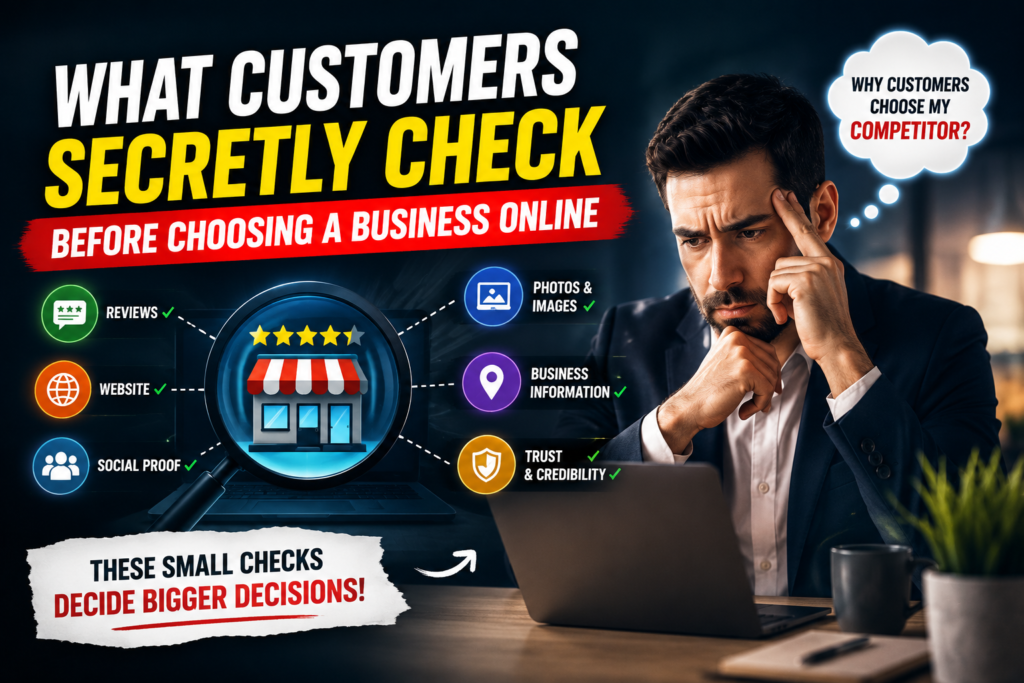
What are customers secretly checking before they choose a business online?
The answer may completely change how you think about your website, marketing, and online presence.
Customers Start Judging Before You Realize It
Imagine you need a service today. Maybe you’re looking for a website designer, a lawyer, a digital marketing agency, a plumber, or a dentist. Like most people, the first thing you would probably do is open Google and start searching.
Within seconds, several businesses appear on the screen. The customer immediately begins comparing options, even before clicking a website.
Without realizing it, their brain is searching for clues that answer one important question:
“Can I trust this business?”
Before customers think about prices, packages, or special offers, they usually think about confidence. Nobody wants to make the wrong decision, especially when money is involved.
This is why trust often influences buying decisions more than business owners realize.
The First Thing Most Customers Check: Reviews
Let’s be honest.
Imagine finding two businesses offering exactly the same service. One business has five reviews while the other has one hundred and fifty positive reviews.
Which one feels safer?
Most people naturally choose the second option. It isn’t because they personally know the company. It’s because reviews reduce uncertainty and provide evidence that other customers have already had positive experiences.
This psychological principle is called social proof.
People often trust the experiences of other customers more than advertising messages. Every positive review helps answer an important concern:
Will this business actually deliver what it promises?
The stronger your reviews, the easier it becomes for customers to feel comfortable contacting you.
Your Website Is Being Judged Within Seconds
🚨 Why Customers Leave Without Contacting You
Customers don’t tell you why they leave.
They simply choose someone else.
Many business owners assume visitors carefully explore every page of their website.
The reality is very different.
Most visitors form an impression almost immediately after arriving. They notice the design, layout, navigation, page speed, images, and overall professionalism before reading much of the content.
If the website looks outdated, confusing, or difficult to use, trust begins to disappear. The visitor may never tell you why they left. They simply click away and continue searching.
A professional website doesn’t just look attractive. It makes visitors feel confident that the business behind it is trustworthy and reliable.
That’s a major difference.
Customers Want Proof That You’re a Real Business
Trust becomes easier when something feels genuine.
This is why customers often look for signs that a business actually exists beyond its marketing claims. They check business addresses, contact information, team photos, customer testimonials, and company details.
Think about your own behavior.
Would you feel comfortable spending money with a business that has no photos, no reviews, no contact information, and very little online presence?
Probably not.
Customers want reassurance. They want evidence that real people stand behind the business they’re considering.
The more authentic your business appears, the easier it becomes to build trust.
Google Business Profile Influences More Decisions Than You Think
🧠 The Customer Decision Journey
Most businesses focus only on traffic.
Successful businesses focus on trust.
Many business owners create a Google Business Profile and then completely forget about it.
Customers do the opposite.
They often check reviews, photos, business hours, location information, and recent updates before making a decision. A complete and active profile immediately feels more trustworthy than an incomplete one.
Remember, customers are usually comparing multiple businesses at the same time.
Small details can create a significant advantage.
When your profile appears professional and up to date, customers feel more confident choosing your business over competing options.
Customers Notice How Active You Are Online
Imagine visiting a company’s social media page and discovering the last post was published a year ago.
Now imagine visiting another company’s page where helpful updates, tips, and content are posted regularly.
Which business feels more active?
Which one feels more trustworthy?
Most people naturally trust businesses that appear engaged and consistent. Regular activity sends a simple message:
This business is operating, active, and paying attention.
Customers may never consciously think about it, but these small signals influence buying decisions every day.
Customers Secretly Ask One Question
Most businesses spend a lot of time explaining what they do.
Customers care about something else.
They want to know:
Can this business solve my problem?
A visitor doesn’t care about your business history until they understand how you can help them. They don’t care about your services until they understand the benefits.
This is where many websites fail.
They focus on describing the business instead of explaining how they solve customer problems.
The businesses that focus on solutions usually build trust much faster.
Customers Compare You With Competitors
Many business owners forget an important reality.
Customers rarely visit one website and immediately make a decision. Instead, they compare several businesses before choosing.
They compare reviews, websites, social media pages, trust signals, photos, testimonials, and overall professionalism.
This means your business isn’t being judged by itself.
It’s being judged beside your competitors.
Even small differences can influence the final decision. A stronger website, better reviews, or a more professional online presence can often be enough to win the customer.
Helpful Content Creates Instant Credibility
Imagine two businesses.
One constantly talks about its services and promotions. The other regularly shares useful information that helps customers solve problems.
Which one feels more trustworthy?
Most people choose the second business.
Helpful content demonstrates expertise. It shows customers that you understand their challenges and know how to provide solutions.
This is why blogs, guides, videos, and educational content work so well. They allow businesses to build trust before the customer even makes contact.
The business that helps first often earns trust first.
Consistency Is a Hidden Trust Signal
Trust doesn’t come from one action.
It comes from consistency.
Customers notice when your website looks professional, your branding feels consistent, your contact information matches across platforms, and your content remains reliable.
Inconsistency creates confusion.
And confusion creates doubt.
The easier it is for customers to understand your business, the easier it becomes for them to trust your business.
Consistency may seem simple, but it plays a major role in customer decision-making.
Why Trust Often Matters More Than Price
Many business owners assume customers always choose the cheapest option.
Real life doesn’t work that way.
Think about your own buying decisions. When something feels risky, confidence often becomes more important than saving money.
Customers frequently pay higher prices when they trust a business more.
Trust reduces fear.
Trust reduces uncertainty.
Trust makes decisions easier.
The business that feels safest often wins, even when it isn’t the cheapest.
📊 Who Would Customers Choose?
| Trust Signal | Your Business | Competitor |
|---|---|---|
| Google Reviews | 15 | 120 |
| Website Quality | Average | Professional |
| Customer Testimonials | Few | Many |
| Google Presence | Weak | Strong |
Now ask yourself:
Which business feels safer?
The Hidden Cost of Ignoring Trust Signals
Most businesses never see the opportunities they lose.
They only see the customers they gain.
Every day, potential customers visit websites, compare businesses, read reviews, and make decisions. Some choose you. Others quietly choose someone else.
The reason isn’t always pricing.
It isn’t always service quality.
Sometimes the difference is simply trust.
And trust is built through dozens of small signals working together.
💡 Reality Check
Customers are already searching.
Customers are already comparing.
Customers are already making decisions.
The question isn’t:
Can customers find your business?
The real question is:
Do they trust your business?
Final Thoughts
Every day customers search online looking for solutions. Before contacting a business, they quietly investigate. They read reviews, check websites, compare competitors, and look for signs that help them feel confident.
Most business owners focus heavily on attracting more traffic. But traffic alone doesn’t guarantee results.
If customers don’t trust what they see, they leave.
The businesses growing online today are often the businesses that make customers feel safest. They build trust through professional websites, positive reviews, helpful content, active online profiles, and consistent communication.
So before asking how to get more visitors, ask a different question:
When customers secretly check my business online, do they find reasons to trust me—or reasons to keep searching?
Because that answer may determine whether they become your next customer or your competitor’